
RED BLOOD CELLS AND NEUTROPHILS
Red blood cells are seen as biconcave disks. Why is this shape important for their function?
Shown in the following photo are red blood cells in a smear, small platelets (p) and a neutrophil with a multilobed nucleus. The drumstick like projection from the nucleus is called a "Barr Body" and represents the condensed X chromosome. This signifies that the blood was taken from a female

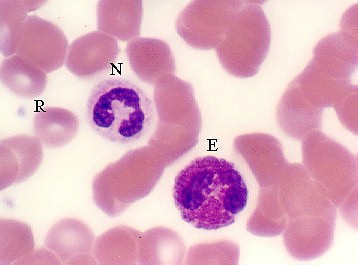
This photo shows an eosinophil (E) and a neutrophil (N). The Eosinophil is distinguished by its red granules and bilobed nucleus. The neutrophil appears to be somewhat immature. How can one draw that conclusion on the basis of morphology?
Click here for more photos of Eosinophils:
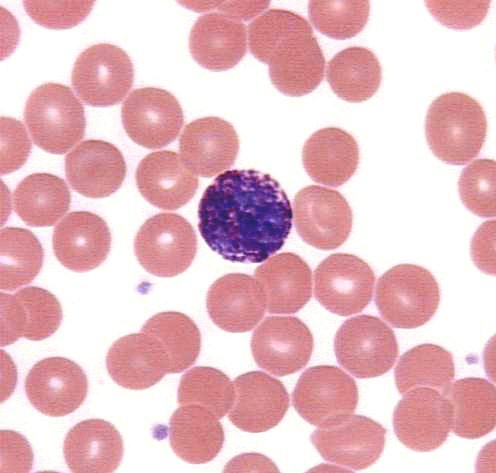
A basophil is characterized by a lobed nucleus and it is filled by large blue-black granules that sometimes cover the nucleus. Here you can see the distinct granules against the purple nucleus. Can you find platelets on this photo?
For more basophils, click here.
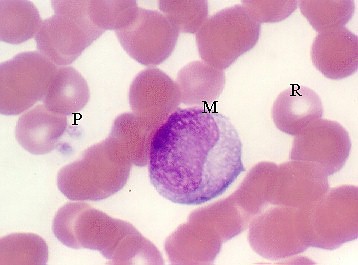
Monocytes are phagocytic and may have vacuoles in the cytoplasm. They also have a horseshoe shaped nucleus or, in immature monocytes, they may have an indented nucleus.

Lymphocytes are only slightly larger than red blood cells (small lymphocytes) and they have a relatively large nucleus:cytoplasm ratio. Note that the lymphocyte in the above photo has only a thin rim of light purple cytoplasm around the dense nucleus.